
“You’re just a man hiding behind questions you’re too scared to answer yourself.” – Sister Barnes
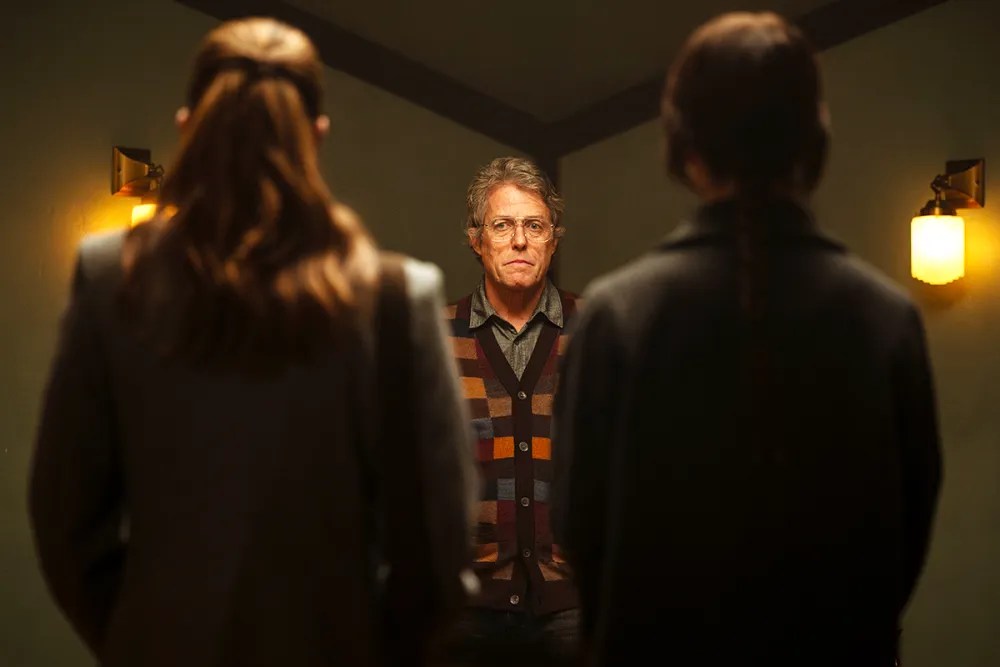
HERETIC (2024, dir. Scott Beck and Bryan Woods) is about two young female Mormon missionaries that get trapped into the house of a literal heretic and must challenge their own beliefs to leave alive. Sister Paxton, played by Chloe East, and Sister Barnes, played by Sophie Thatcher, delivered an accurate portrayal of what it’s like to be young women venturing out to stranger’s homes to relay a spiritual message. That by itself is horrifying.
However, despite the obvious horror of being trapped in a house with an unpredictable man, Mr. Reed, played by Hugh Grant, this film transcends the typical religious horror film cliches (bloody jumpscares, demons, priests chanting “You are not welcome here!”, etc…) with something that creates an undeniable tension from the start: a conversation. More than that– an open dialogue that is critiquing another’s religion, not out of a place of malice, but for real dialogue and analysis.
Uncomfortable Conversations
When Mr. Reed invites the women into his home, he seems excited to just talk and get their perspective on Mormonism. Surprisingly, he already knows a lot and references the start of Mormonism when Joseph Smith experienced a miracle– Smith was visited in the night by an angel and was able to translate ancient texts. When he brings out his own Book of Mormon, Sister Paxton notices the annotations flooding out of his book and says if anything, they should probably be learning from him. Incredible foreshadowing!
So they do. They have uncomfortable conversations (including a very uncomfortable one about polygamy and it’s place in the Mormon church), and after realizing they are not leaving the house under their own free will, they are forced to get a history lesson. A biased one? Somewhat. I will say, at first Mr. Reed seemed like a guy who spent too much time on Reddit mansplaining religion and how there are similar themes throughout all of them. Mr. Reed, though, proves that he is more than that. He is a bonafide heretic, with his own gallery of religious ideology, imagery, and a mini church built into his own house. (Granted– I did almost change my mind when he found a small rod in Sister Barnes’s arm and says Look, she’s not real. An NPC. And Sister Paxton had to break the news to him that she was not, in fact, a “fake” soul. She just had birth control. Men. More on this later.”
Deeper into the conversation, Mr. Reed brings up a telling point: the women agreed to come into his house under the rule female Mormons follow that there must be another woman present. Mr. Reed assures them that his wife is in the kitchen and will be out shortly. The women, their anxiety mounting, urge Mr. Reed to please have his wife present. He pretends to look. Then says something along the lines of, “Did you really believe that I have a wife? Just because I told you, you believed it?” The women’s faces quickly faded to a paler white. And that, THAT, is really the core of the film’s message. As a society, we have fell into a trap. We teach our kids to believe in Jesus Christ or Buddha or Joseph Smith, and they grow up to tell their kids to believe in Him, and then their kids, and their kids, and it goes on and on. But are we actually teaching them anything about the religion other than the rules to follow? Are we just believing for the comfort of safety, like these two women? The women play his game to avoid any harm, and unfortunately, that’s all they face despite their choices– Sister Barnes ends up dead in the basement soon after as a sacrifice for Mr. Reed’s twisted religion.
This brings me back to a point Mr. Reed made that I mentioned before– polygamy in Mormon history. It’s not something they allow or advocated for since 1890. The church president at that time, Wilord Woodruff, said he was “inspired by God to issue a declaration” to abolish polygamy practices within the community. Or maybe it was because the U.S. government threatened to dissolve their assets and Woodruff did not want the Mormon church to disappear. I’m not telling you what to believe. But Mr. Reed did make a compelling point. Did the Mormon church also try to appeal to the the youth by disavowing polygamy, going against what the sacred prophet Joseph Smith said to do so? I think so. This isn’t unique to Mormonism; Christianity, Judaism, Islam, Buddhism– ALL religions do this. They are aware of some of the ugly and debatably unjust teachings in early versions of their holy text and they adopt it to further their own agendas, trying their best to appeal to current society. It doesn’t work, though. Changing or cherry-picking a religion to appeal to the masses devalues the original intent of the religion itself. Religion is made by flawed humans trying to grasp any comfort in the fact that they will not live forever. HERETIC confronts that awful reality.
I want to be clear: I am NOT advocating to stop practicing your religion. Nor do I think this film is advocating for that either. I do think, however, the character’s journeys in this film are advocating for the self discovery of religion and promoting research into one’s faith. Organized religion still has a LOT of work to do.

The One and Only “True” Religion
During the last act, Mr. Reed finally reveals what is the “one and only true religion.” He says it’s control. Forcing people to believe and to capture them at their most vulnerable. I think that’s what major religions have definitely done in the past and continue to do but under a more watchful eye (laws, governments, people). This is what Mr. Reed also shows throughout his actions in the film, feigning the idea of free will to the women and then taking it away, teasingly.
Then something happens. As Mr. Reed is close to death from Sister Paxton’s vengeful stab in the neck, he does something strange that seems to counter everything else that he’s done in the entire film. Sister Paxton, also bleeding out from a stab she received from Mr. Reed, starts to explain The Harvard Prayer Experiment from 1997. It was conclusive: the effects of the prayer did nothing. The prayers had no effect on the recovery of all groups. Yet, she starts to pray anyway. Mr. Reed drags himself across the floor to reach Sister Paxton. He holds the same box cutter used to stab her. We think he’s getting closer to slit her throat to stop her from praying. But when he gets to her, that’s not his immediate response. He places his head on her chest and listens. It’s not for long. But he listens! Then, frustrated for allowing himself to find some peace in the prayer, he holds his box cutter to her throat. He almost slits it, but we’re jump scared by a resurrected Sister Barnes caving his face in with a nailed plank. Like an angel in the night.
This got me thinking: what really is the point of all of these religions? Not to prove who is right or to be enlightened. It’s just for comfort. That is the real religion. How people choose to cope is where the organized religion comes in.
It’s not control. It’s comfort.
Things I Loved
I loved how the film used several parallels or brought back information that seemed irrelevant at the time.
Additionally, the characters were both refreshing to see. They are like a typical “opposites attract” duo– Sister Barnes seemed like the cynic, black hair, intelligent, strong, whereas Sister Paxton seemed like the optimist, blonde hair, naivety, insecure. But they totally break out of those cliches at the end of the film. Sister Paxton’s character genuinely surprised me with just how observant she was. Sister Barnes seemed to get more anxiety and let her emotions control her decisions at points. This made me feel the characters more as actual people and not just a two-dimensional character.
The cinematography was by Chung-hoon Chung, a South Korean cinematographer and writer. This is the first film I’ve seen from him in both roles and I am excited to check out his other work because HERETIC was beautiful. The lighting and softness of the shots posed a great contrast to the unsettling and dangerous situation the women were in. The shots were thoughtful and did not waste any potential of giving us information into the world we were in.
I hate jumpscares, and this film had a couple. But they were SO good. Just the simple action of the light turning off made me jumpy. I felt like I was in the same room as the characters.
Speaking of the characters, all of them gave a wonderful performance. Hugh Grant had me fighting between if I would walk to this character’s house and purposefully let myself in just to talk to him about religion or sprint as fast as I can away from him. He was expertly playing a character that was wearing a mask, and we never really got to see through that mask. Chloe East and Sophie Thatcher both leaned on each other’s performance and it paid off in giving me stakes into these women and really rooting for them to escape together. When they didn’t it was heart-breaking. East grew up in the Mormon faith but no longer practices. This made her the best choice for the film because she had to relive that again– the self-discovery of religion, by playing Sister Paxton. It was emotional truth. Barnes played dark and mysterious to an elevated level by allowing her character to show cracks in her confidence, emotion just barely spilling from her subtle facial expressions.
I would love to see more of what entire cast and crew have to offer in the future. This film will be a staple from A24.
Comment down below and let me know what your thoughts on the film, if you agree, disagree, whatever! Thanks for reading.


 MIRLVNV
Leave a reply to Ken Harvey Cancel reply